
Direct answer
Vietnam exporters of EUDR-relevant goods should use the final quarter of 2026 to align product scope, traceability, geolocation, legality evidence and shipment data with their EU customers. The EUDR applies from 30 December 2026 to large and medium EU operators, while most micro and small operators move to 30 June 2027. The operational risk for exporters is not only customs delay—it is cargo being commercially unready because the buyer cannot complete due diligence.

Why this matters now
The compliance window is becoming operational, not theoretical. On 18 September, Vietnam’s Ministry of Industry and Trade highlighted a newly published EU amendment clarifying the EUDR product scope. The European Commission has also reopened and updated its EUDR Information System, published implementation guidance and confirmed the staggered application dates.
For Vietnam, the exposure is commercially important because EUDR covers commodities and derived products that are significant export categories, including coffee, rubber and wood. Vietnamese authorities are actively standardising farm and land-use data to support compliance, including coffee traceability work in Son La, Lam Dong, Dak Lak and recent land-use reviews in Gia Lai.
Key Takeaways for Vietnam Exporters
The first main application date is 30 December 2026 for large and medium EU operators, plus micro/small operators already covered by the former EU Timber Regulation. Most other micro and small operators move to 30 June 2027.
The EUDR covers cattle, cocoa, coffee, oil palm, rubber, soy and wood, plus specified derived products. Product scope must be checked at the exact CN/HS classification level.
The legal due-diligence obligation sits mainly with EU operators/importers, but Vietnam suppliers may need to provide geolocation, production, legality and chain-of-custody information so the EU party can submit its due diligence statement.
Recent EU amendments clarify exclusions and additions. Some newly added products under Regulation (EU) 2026/2102 will not become subject until 30 December 2027.
Logistics teams should connect compliance data to the shipment workflow before booking and document cut-off, rather than trying to fix missing data after cargo is gated in.
What EUDR Requires from Vietnam Exporters in Practical Supply-Chain Terms
At a high level, relevant products placed on or exported from the EU market must be deforestation-free, produced in accordance with relevant laws in the country of production, and covered by due diligence. The EU operator must be able to support its declaration with supply-chain information, including geolocation and evidence necessary to assess risk.
For a Vietnam exporter, this means the commercial question is not simply ‘Do we have an EUDR certificate?’ There is no single exporter certificate that replaces the EU operator’s due diligence. The practical requirement is to build a reliable data package that the importer can use.
Which Vietnam Exporters Should Pay Attention to EUDR?
| Commodity / product family | Why relevant | Operational focus |
| Coffee | Core EUDR commodity; EU buyers may require plot-level origin and deforestation-risk evidence | Farm geolocation, supplier mapping, lot traceability, buyer data format |
| Rubber | Core EUDR commodity and selected derived products | Plantation origin, chain-of-custody, product classification |
| Wood / furniture inputs | Wood is a core commodity; many derived products may be in scope | Species/source legality, geolocation, material segregation, CN code scope |
| Other derived products | Coverage depends on the exact Annex I product code | Do not assume inclusion or exclusion from product description alone; verify classification |
A Six-Step EUDR Readiness Checklist for Vietnam Exporters

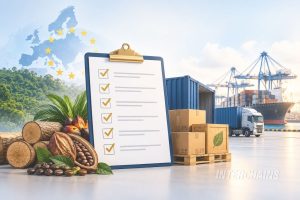
- Map the product scope. Confirm the HS/CN code with the EU buyer and check whether the exact product is listed in the EUDR scope. Recheck products affected by the September 2026 scope clarification.
- Identify the EU-side responsible party. Confirm whether the consignee/importer is the operator that will place the goods on the EU market and what data format they require from the Vietnam supplier.
- Build traceability to production origin. Maintain supplier, farm/plantation/forest source, lot and geolocation data at the level needed by the buyer’s due-diligence process.
- Validate legality and chain-of-custody documents. Ensure the evidence used for production legality and material movement is consistent with invoices, packing lists, purchase records and production batches.
- Connect compliance to shipping documents. Align product description, HS/CN classification, lot/batch references, consignee details and supporting references before SI/VGM/document cut-off where applicable.
- Create an exception process. If a source lot lacks acceptable geolocation or legality evidence, hold or segregate it before stuffing rather than allowing non-ready cargo to mix with compliant lots.
The Logistics Risk: Why Compliant Products Can Still Become Failed Shipments for Vietnam Exporters
EUDR is primarily a market-access and due-diligence regime, but its failure modes can appear inside logistics operations. A shipment may be physically ready while the importer is not ready to place it on the EU market because required traceability data is missing, inconsistent or late.
| Operational rule: Treat EUDR data readiness as a pre-booking or pre-stuffing gate for affected cargo—not as a document clean-up task after the container is on the water. |
What Recent EU and Vietnam Updates Mean for Vietnam Exporters
Recent regulatory updates are making EUDR preparation increasingly important for Vietnam exporters shipping covered commodities and products to the European Union. Understanding the latest application dates, product-scope changes, and traceability developments can help exporters identify compliance gaps before they affect shipments.
The European Commission confirms that the main EUDR application date is 30 December 2026 for large and medium-sized operators, while 30 June 2027 applies to most micro and small operators. Micro and small operators already covered by the EU Timber Regulation (EUTR) are also subject to the 30 December 2026 date. In addition, certain newly added products under Commission Delegated Regulation (EU) 2026/2102 will have a later application date of 30 December 2027, giving businesses additional time to prepare.
For Vietnam exporters, the latest changes also highlight the importance of checking product classification carefully. On 18 September 2026, Vietnam’s Ministry of Industry and Trade reported on the EU’s updated product scope. Under the new provisions, certain packaging used only to support, protect, or contain another product is generally excluded from EUDR, while packaging marketed as a product in its own right may still fall within scope. Other exclusions and additions also apply, making it important to assess the specific product, HS classification, and commercial context rather than relying on assumptions.
At the production and traceability level, Vietnam is also strengthening the data infrastructure needed for EUDR readiness. The Ministry of Agriculture and Environment reported that a national coffee farm database pilot in Lam Dong and Dak Lak has collected data covering more than 151,000 hectares since January 2024. In September 2026, authorities also worked in Gia Lai on land-use and land-rights data associated with coffee-growing areas, an important element of EUDR due diligence.
For Vietnam exporters, these developments point to a practical shift: EUDR preparation is not only about understanding the regulation, but also about ensuring that product classification, farm-level traceability, land-use information, due-diligence data, and shipment documentation are aligned before cargo moves.
Recommended Workflow for Vietnam Exporters, Importers and Forwarders
| Stage | Vietnam exporter | EU importer/operator | Forwarder / logistics provider |
| Before booking | Confirm scope, lot, source and data package | Confirm due-diligence role and data requirements | Flag EUDR-sensitive cargo and required document timing |
| Before stuffing | Segregate compliant lots; freeze lot/batch references | Validate that required source data is usable | Match booking/SI data to commercial documents |
| Before departure | Resolve inconsistencies | Prepare/complete required due-diligence workflow | Check document cut-off and final shipping data |
| Arrival / release | Support clarification if requested | Manage EU compliance and market-placement obligations | Support transport/document execution; do not substitute for legal compliance |
Interchains View: Making Compliance Data Part of Cargo Readiness for Vietnam Exporters
The strongest logistics response to EUDR is process discipline. Exporters should not wait until December to ask what the buyer needs. The data chain should be tested now on real purchase orders and real lots so that commercial, documentation and operations teams know what must be ready before booking.
Interchains can support the transport side of this process by aligning booking, document cut-offs, shipment descriptions, routing and handover requirements with the exporter and EU consignee. EUDR legal due diligence remains the responsibility of the relevant economic operators and their compliance advisers; logistics execution should support that process, not replace it.
Frequently Asked Questions About EUDR for Vietnam Exporters
Does every Vietnam exporters have to submit an EUDR due diligence statement to the EU system?
Not generally. The obligation to submit the due diligence statement sits with the relevant EU operator under the regulation. Vietnam suppliers may need to provide the underlying traceability and legality information required by that operator.
Is every wood, rubber or coffee product automatically in scope?
No. Scope depends on the exact commodity/product and code listed in the EUDR annex, including later amendments. Check the exact classification with the EU customer.
What is the main deadline?
30 December 2026 for large and medium operators and certain micro/small operators already covered by the former EUTR; most other micro and small operators move to 30 June 2027. Some products newly added in 2026 have a later 30 December 2027 date.
Should the forwarder certify EUDR compliance?
A forwarder can support data consistency and shipment execution, but should not replace the legal due-diligence responsibilities of the EU operator or specialised compliance advisers.
Sources and method
This article uses European Commission and Vietnam government sources for scope, dates and implementation updates. It is an operational logistics guide, not legal advice. Companies should verify product classification and legal obligations with their EU customer and qualified compliance advisers.
[1] Regulation on Deforestation-free Products. European Commission – DG Environment, accessed 28 Sep 2026. Source — Application dates and scope
[2] Commission updates product scope and tools to support EUDR. European Commission – DG Environment, 13 Jul 2026. Source — Scope/tool update and application timing
[3] FAQ on EUDR Implementation. European Commission – DG Environment, 21 Aug 2026. Source — Implementation guidance
[4] EU publishes amended product list under EUDR. Vietnam Ministry of Industry and Trade, 18 Sep 2026. Source — Vietnam-facing summary of Regulation (EU) 2026/2102
[5] Son La coffee accelerates data standardization to comply with EUDR. Vietnam Ministry of Agriculture and Environment, 28 Jul 2026. Source — Vietnam coffee traceability readiness
[6] Land-use review in Gia Lai for EUDR adaptation. Vietnam Land Administration / MAE, 18 Sep 2026. Source — Recent Vietnam implementation activity
Compliance disclaimer: This article is for logistics planning and operational readiness only and does not constitute legal advice. Product scope and obligations should be confirmed against current EU legislation and the relevant importer/operator requirements.
