
Vietnam-Japan trade exceeded USD 51 billion in 2025. In 2026, exporters should treat Japan as a stable but compliance-sensitive market where documentation, labeling, quarantine and pre-departure filing discipline decide market access.
Key Takeaways for Exporters
- Vietnam-Japan trade crossed USD 51.43 billion in 2025, with Vietnam exporting USD 26.77 billion to Japan and importing USD 24.68 billion from Japan.
- Japan is not a pure low-price market. It is a quality, documentation and reliability market where exporters must manage product compliance before shipment, not after arrival.
- For containerized cargo, Japan Advance Filing Rules require shipping companies or NVOCCs to submit maritime container cargo information to Japan Customs in principle no later than 24 hours before vessel departure from the port of loading.
- Food, agricultural, plant, seafood, food-contact packaging, textile and chemical-related shipments require stricter pre-shipment checks, import-side coordination and traceability evidence.
- Interchains view: Vietnam-Japan trade can continue expanding in 2026-2027, but the winners will be exporters that combine competitive production with Japanese-grade compliance and shipment discipline.
What happened
Japan has become one of Vietnam’s most resilient developed-market trade partners. In 2025, bilateral trade passed the USD 50 billion threshold for the first time, a structural milestone rather than a one-off seasonal increase. The trade mix is complementary: Vietnam sells labor-intensive, consumer, food and manufacturing products into Japan, while Japan supplies machinery, components, production inputs and technology that support Vietnam’s industrial base.
The opportunity in 2026 is therefore not limited to more volume. It is about moving up the quality curve. Vietnamese exporters can use Japan as a premium reference market if they are able to meet buyer expectations on documentation, safety, packaging, labels, delivery reliability and traceability. For logistics teams, this means Japan shipments should be managed as compliance-driven shipments, even when the lane looks operationally simple compared with long-haul USA or Europe cargo. As Vietnam enhances its trade relations with Japan in 2026, exporters must prioritize adherence to Japan’s import regulations and food import compliance to successfully export to Japan. Understanding the Japan AFR is crucial for navigating the complexities of the market. Additionally, efficient Vietnam to Japan logistics will play a pivotal role in ensuring timely deliveries while meeting stringent buyer expectations. By focusing on quality and compliance, Vietnamese businesses can strengthen their foothold in this premium market.
Market signals Interchains is watching
| Signal | Latest fact |
Vietnam exporter implication
|
| Trade milestone | Vietnam-Japan two-way trade reached USD 51.43 billion in 2025, up 11.28% year on year. Vietnam recorded a USD 2.09 billion surplus with Japan. |
Positive base for 2026 RFQs, especially food, consumer goods, apparel, electronics, machinery parts and wood products.
|
| Japan demand profile | OECD projects Japan real GDP growth at 0.6% in 2026 and 0.8% in 2027, with domestic demand still supported by wages, subsidies and investment. |
Demand is stable but selective. Exporters should not assume broad-based volume growth; quality positioning matters.
|
| Modern retail access | Vietnam Goods Week 2026 with AEON expanded across more than 400 AEON stores in Japan, and new Vietnamese SKUs doubled versus previous editions. |
Modern retail can become a scalable route for Vietnamese food, FMCG, rice-based products, dried fruits, cashew, seasonings and household goods.
|
| Compliance intensity | Japan maintains strict rules on food import notifications, plant quarantine, food labeling, food-contact packaging and chemical substances. |
Compliance review must be part of quotation and production planning, not a last-minute document exercise.
|
Why Japan matters for Vietnamese exporters
Japan is attractive because it combines high purchasing power, reliable payment culture, sophisticated retail standards and stable industrial demand. Vietnamese export categories with strong relevance include textiles and garments, transport vehicles and parts, machinery and equipment, wood and wood products, phones and components, computers and electronic components, footwear, seafood, coffee, fruits and vegetables, cashew nuts and pepper.
However, Japan is also a market where small errors can become commercial problems. A vague cargo description can delay advance filing. A missing phytosanitary certificate can stop plant-origin cargo at import inspection. Incorrect Japanese labeling can prevent retail sale. Food-contact packaging that lacks substance declarations can slow down buyer approval. A supplier declaration that does not address PFAS-related substances can become a risk for textile or water-repellent products.
For this reason, the Japan opportunity should be managed through a cross-functional operating model: sales confirms buyer requirements, documentation validates product and shipping data, operations locks cut-off and route details, and the exporter confirms regulatory evidence before cargo is delivered to CFS or CY.
Vietnam-Japan logistics lane view
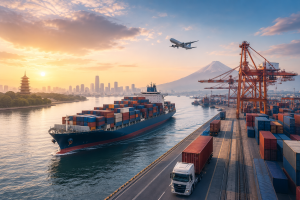
Vietnam to Japan is operationally shorter than many long-haul lanes, but it is not automatically low-risk. Export flows from Ho Chi Minh City, Cai Mep, Haiphong and Lach Huyen typically connect to key Japanese consumption and industrial gateways such as Tokyo, Yokohama, Nagoya, Osaka, Kobe, Hakata, Moji and other regional ports. Depending on service design, cargo may move direct, through a regional transshipment hub or via feeder connection.
The most important operational discipline is data quality. Japan Customs’ Advance Filing Rules apply to containerized maritime cargo loaded on a vessel intended to enter Japan. Shipping companies or NVOCCs are required to submit cargo information in principle no later than 24 hours before vessel departure from the port of loading. This is especially relevant when a forwarder issues HBL, because house-level data, cargo description and consignee information must be clean and timely.
For LCL cargo, the risk is concentrated in consolidation accuracy. A mismatch between HBL description, invoice, packing list, product label and consignee instruction can create a disproportionate delay for a small shipment. For temperature-sensitive food, seafood and high-value retail cargo, exporters should also validate reefer settings, loading temperature, shelf-life margin, fumigation or treatment requirements and buyer receiving windows before cargo is stuffed.
Compliance checklist for exporters to Japan
| Area | What to check | Practical action |
| Japan AFR / JP24 | Confirm accurate shipper, consignee, notify party, cargo description, HS if required, container details and HBL/MBL alignment before filing cut-off. |
Avoid generic descriptions such as “parts”, “foodstuff”, “sample” or “general cargo” without product detail.
|
| Food and seafood | Japan Food Sanitation Act import notification is required for food, additives, apparatus, containers and packaging intended for sale or business use. |
Prepare ingredient list, manufacturing process, additives, test results, factory data and importer-side notification support.
|
| Agricultural / plant products | Phytosanitary certificate and import inspection are legally required for plants and many plant products entering Japan. |
Check product eligibility, origin, treatment, certificate format and inspection plan before booking.
|
| Food labeling | Food labeling for sale in Japan must be in Japanese. CAA guidance covers origin, allergen, expiration date, nutrition and health claims. |
Do label review before mass production. Do not rely on English-only packaging for retail-ready goods.
|
| Food-contact packaging | Utensils, containers and packaging must meet Japanese specifications and standards. Positive-list compliance is important for synthetic resin food-contact materials. |
Collect material composition, supplier declaration, migration or conformity data from packaging vendors.
|
| Textiles / water-repellent goods | Japan has moved to regulate PFHxS-related compounds as Class I Specified Chemical Substances, including prohibitions on designated water- and oil-repellent textile products containing these compounds. |
Ask suppliers for PFAS/PFHxS declarations and test reports before quoting Japanese buyers.
|
| Commercial documents | Invoice, packing list, COO, booking, SI, HBL/MBL and product labels must describe the goods consistently. |
Build one shipment data sheet and use it across all parties to reduce mismatches.
|
What exporters should do before accepting a Japan order
- Classify the product correctly. Confirm HS code, product category, material composition, intended use and whether the product falls under food, plant, animal, chemical, textile, electrical or retail labeling controls.
- Align with the Japanese importer early. The importer is often the party responsible for import notification, retail labeling and market release, but the exporter must provide the evidence.
- Build a document pack before production finishes. For food and FMCG cargo, include ingredient list, additive list, manufacturing process, packing material details, test certificates and shelf-life data.
- Protect shipment timing. Japan buyers value delivery discipline. Confirm CY/CFS cut-off, AFR data deadline, sailing schedule, transshipment risk, consignee receiving window and public holidays.
- Avoid last-minute label corrections. Japanese labeling is not just translation; it is a compliance format. Review allergen, origin, nutrition, date marking and importer details before packing.
- Use logistics as a sales advantage. A clean export process, reliable tracking and proactive compliance checklist can help Vietnamese suppliers win repeat orders from Japanese buyers.
Interchains forecast: H2 2026 to 2027
| Scenario | Theme | What it means | Exporter action |
| Base case | Stable expansion | Vietnam-Japan trade continues to grow moderately as Japan remains a reliable market and Vietnam improves product quality. Compliance requirements remain strict but manageable for prepared exporters. |
Prioritize repeat buyers, modern retail channels, food, consumer goods, machinery parts, electronics-related components and wood products.
|
| Bull case | Retail and supply-chain upgrade | More Vietnamese brands enter Japanese retail and regional AEON-linked channels. Japan buyers diversify sourcing from China-plus-one and ASEAN partners. |
Invest in Japanese packaging, quality certification, traceability, brand story and greener supply chains.
|
| Bear case | Compliance and cost pressure | Yen weakness, higher import costs, tighter inspections or documentation errors reduce margins and cause shipment delays. |
Do not compete only on price. Build compliance buffers, shipment lead-time buffers and stricter pre-shipment checks.
|
Interchains view
Japan should be treated as a strategic market for Vietnamese exporters, not merely a destination port. The strongest opportunity is for exporters that can meet Japanese quality expectations consistently while using logistics discipline to protect shelf life, delivery windows and documentation accuracy. This is where a freight forwarder can create real commercial value: by connecting trade intelligence, product compliance, carrier execution and document control into one operating process.
For exporters, the right question is not only “What is the ocean freight to Japan?” The stronger question is: “Can this shipment clear, be released, be sold and be repeated without avoidable compliance friction?” In the Japan market, that question decides whether a first order becomes a long-term account.
Planning shipments from Vietnam to Japan? Interchains can support shipment planning, carrier selection, HBL/MBL coordination, Japan AFR data control, food and retail documentation workflow, and practical logistics planning for FCL and LCL exports. Contact our team to review your next Japan shipment before booking and production cut-off.
Source notes
Sources were used for factual verification and market signal validation. Accessed on 23 June 2026 unless otherwise noted.
- VietnamPlus – Vietnam-Japan trade surpassed USD 50 billion in 2025: https://en.vietnamplus.vn/vietnam-japan-trade-surpasses-50-billion-usd-for-first-time-post335587.vnp
- OECD – Japan Economic Outlook, June 2026: https://www.oecd.org/en/publications/2026/06/oecd-economic-outlook-volume-2026-issue-1_8be0dba6/full-report/japan_d6df5896.html
- Vietnam Ministry of Industry and Trade – Vietnam Goods Week 2026 with AEON: https://moit.gov.vn/en/news/ministry-of-industry-and-trade-and-aeon-launch-vietnam-goods-week-2026-across-japan-and-asian-markets.html
- Japan Customs – Advance Filing Rules on Maritime Container Cargo Information: https://www.customs.go.jp/english/summary/advance5/index.htm
- MHLW Japan – Imported Food Safety and Food Sanitation Act import procedure: https://www.mhlw.go.jp/stf/seisakunitsuite/bunya/kenkou_iryou/shokuhin/yunyu_kanshi/index_00017.html
- MAFF Japan – Plant Quarantine Inspections: https://www.maff.go.jp/pps/j/introduction/english.html
- Consumer Affairs Agency Japan – Food Labelling: https://www.caa.go.jp/en/policy/food_labeling/
- MHLW Japan – Utensils, Containers and Packaging standards: https://www.mhlw.go.jp/stf/seisakunitsuite/bunya/kenkou_iryou/shokuhin/kigu/index_00003.html
- METI Japan – PFHxS-related compounds under CSCL: https://www.meti.go.jp/english/press/2025/1212_001.html
- CIRS – Japan voluntary front-of-pack nutrition labelling guideline update: https://www.cirs-group.com/en/food/japan-caa-publishes-voluntary-front-of-pack-nutrition-labelling-guidelines-for-processed-foods
