
Vietnam shippers should treat Upper Gulf bookings as a controlled exception, not routine ocean freight. As of 4 September 2026, vessel traffic through Hormuz remained sharply depressed, while carrier networks relied on selective acceptance, alternative ports and landbridge solutions. Before cargo moves, confirm booking acceptance, discharge plan, onward transport, empty return, surcharges and cargo insurance in writing.
Strait of Hormuz Disruption: A Vietnam–Upper Gulf Booking Guide for September 2026
Key Takeaways: Strait of Hormuz Disruption
- A low headline ocean rate is not decision-ready unless it includes the contingency route, terminal/storage exposure, empty-return plan and inland leg.
- Jebel Ali availability is carrier-, cargo- and routing-specific; “port open” does not mean every service or booking is operating normally.
- Alternative gateways such as Khor Fakkan, Salalah, Sohar, Jeddah and Aqaba can preserve cargo flow, but may add handoffs, inland distance and documentation risk.
- Reefer, dangerous goods, time-critical cargo and shipments already on water require separate escalation paths.
- Use shorter quotation validity and hold a routing/risk review before empty pickup or stuffing.
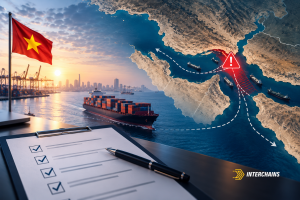
What Changed This Week in Hormuz Shipping?
Reuters reported that only four commodity vessels crossed the Strait of Hormuz on 3 September, compared with a 10-day average of about 15. The count excludes vessels operating with AIS transponders switched off, so it is not a complete tally; nevertheless, it confirms that visible traffic remained materially constrained. The same report said Bab el-Mandeb traffic was also below its 10-day average, showing that Gulf and Red Sea risks can overlap rather than move independently.
Carrier implementation is equally important. Maersk’s 31 August operational update listed paused landside flows on several UAE/Qatar–Jeddah/Oman corridors, selective landbridge availability and booking restrictions by cargo type and destination. CMA CGM’s Middle East update retained emergency fuel and dangerous-goods measures, while Hapag-Lloyd continued to describe Jebel Ali calls as ad hoc in its August operational reporting. These are not interchangeable rules: the controlling instruction is the one attached to the chosen carrier, service and booking confirmation.
Current Operating Picture: Strait of Hormuz Shipping Disruption
| Signal | Verified position | Commercial implication |
| Hormuz traffic | Four observed commodity-vessel transits on 3 Sep; 10-day average about 15 (Reuters/Kpler). | Do not assume normal sailing frequency or connection reliability. |
| Maersk network | Selective Upper Gulf acceptance, alternative ports/landbridges, and route-specific pauses as of 31 Aug. | Validate ocean and inland legs as one executable plan. |
| Jebel Ali cargo | Temporary storage for specified transshipment cargo; import/COD storage may follow terminal tariffs. | Separate freight from storage, plug-in, COD and local costs. |
| Empty equipment | Return/pick-up locations and drop-off charges vary by country and equipment. | Confirm depot acceptance and return instruction before delivery. |
| Alternative gateways | Aqaba transit cargo rose strongly in H1 2026 as Iraq flows shifted away from the Gulf. | Alternative routing is viable but inland cost and border risk rise. |
What this means: the operational problem is no longer only whether a vessel can cross Hormuz. The booking must also survive transshipment, storage, inland transfer and empty-equipment execution.
Vietnam Shippers: Where Upper Gulf Shipping Costs Can Escape the Quotation
For cargo originating in Ho Chi Minh City, Cai Mep or Hai Phong, the most dangerous quotation gap is the distance between an advertised POD and the consignee’s real delivery point. A route shown to Jebel Ali may ultimately depend on Khor Fakkan, Salalah, Sohar, Jeddah or Aqaba plus an inland connection. That changes who controls the container, which customs regime applies, where the delivery order is issued and where the empty unit must be returned.
- Base ocean freight versus emergency fuel, conflict, dangerous-goods, storage, reefer plug-in, COD and inland contingency charges.
- Carrier haulage versus merchant haulage, including border permits, trucking capacity and liability handover.
- Published POD versus actual discharge/transshipment port and final place of delivery.
- Free time at the booked destination versus storage exposure at a contingency hub.
- Cargo insurance scope, war-risk exclusions and whether rerouting changes coverage.
Vietnam–Upper Gulf Shipping: Booking Decision Matrix
| Cargo situation | Recommended decision | Minimum written confirmation |
| Standard dry; flexible delivery | Compare at least two executable routes; allow schedule buffer. | Acceptance, actual routing, POD/place of delivery, inland mode, empty return, all surcharges. |
| Time-critical or production-stop | Consider split shipment or air/ocean combination; price delay exposure. | Connection protection, contingency trigger, cargo priority, insurance. |
| Reefer/perishable | Escalate before booking; do not rely on general dry-cargo acceptance. | Reefer acceptance, plug-in points, power continuity, monitoring, claims protocol. |
| Dangerous goods | Obtain carrier-specific approval and surcharge confirmation. | UN/class details, accepted ports, DG surcharge, documentation cut-off. |
| Cargo already on water | Request vessel-level status and cost-responsibility map. | Discharge plan, storage start date, COD option, onward leg, payer for extra charges. |
Seven Pre-Booking Controls for Hormuz-Affected Shipments
- Define the true delivery requirement: port, city, final facility and latest acceptable arrival.
- Request carrier confirmation for the exact cargo type, equipment and service—not only a tariff.
- Map the physical route from Vietnam POL through every hub to final delivery.
- Build an all-in cost sheet separating known, conditional and pass-through charges.
- Confirm free time, storage start, reefer plug-in and empty-return instructions.
- Review insurance and force-majeure/war-risk wording with the cargo owner or broker.
- Set a trigger for re-quotation or routing change if acceptance, security or port status changes.

In a disrupted Upper Gulf market, the strongest option is not automatically the lowest ocean line. It is the route with the fewest unpriced handoffs and the clearest responsibility from Vietnam origin to delivery and empty return. Interchains can support FCL/LCL route comparison, carrier acceptance checks and all-in booking-risk reviews for Gulf cargo.
Frequently Asked Questions About Strait of Hormuz Disruption
Is Jebel Ali closed?
The issue is not a single yes/no port status. Carrier calls and booking acceptance are selective, and some cargo moves through alternative gateways or landbridges. Verify the chosen service and booking.
Can a shipper rely on the quotation validity date?
Only if the quotation also states what happens when routing, surcharges or contingency costs change. In volatile conditions, operational confirmation can expire before the printed rate validity.
Does free time protect against contingency-hub storage?
Not necessarily. Destination free time and temporary storage at a transshipment or contingency location may be governed by different terms.
Should Vietnam exporters stop booking the Upper Gulf?
Not categorically. They should use cargo-specific acceptance, alternative-route comparison and a documented contingency plan before cargo handover.
Request a Vietnam–Gulf route and risk review
Send Interchains your POL, final delivery point, cargo type, equipment, ready date and required arrival date. We will compare available routing, known surcharges and execution risks before booking. Contact
Sources and method
This article separates public facts from Interchains analysis. Carrier restrictions, charges and schedules can change without notice; shipment-specific confirmation remains necessary before booking.
- Reuters, “Gulf shipping traffic via Hormuz keeps below 10-day average, data shows,” 04 Sep 2026
- Maersk, “Middle East Operational Update 44,” 31 Aug 2026
- CMA CGM, “Middle East Situation Updates,” accessed 04 Sep 2026
- Hapag-Lloyd, “Week 34 – Middle East Operational Update,” 17 Aug 2026
- Reuters, “Jordan’s Aqaba port sees transit cargo boost amid Hormuz disruption,” 01 Sep 2026
